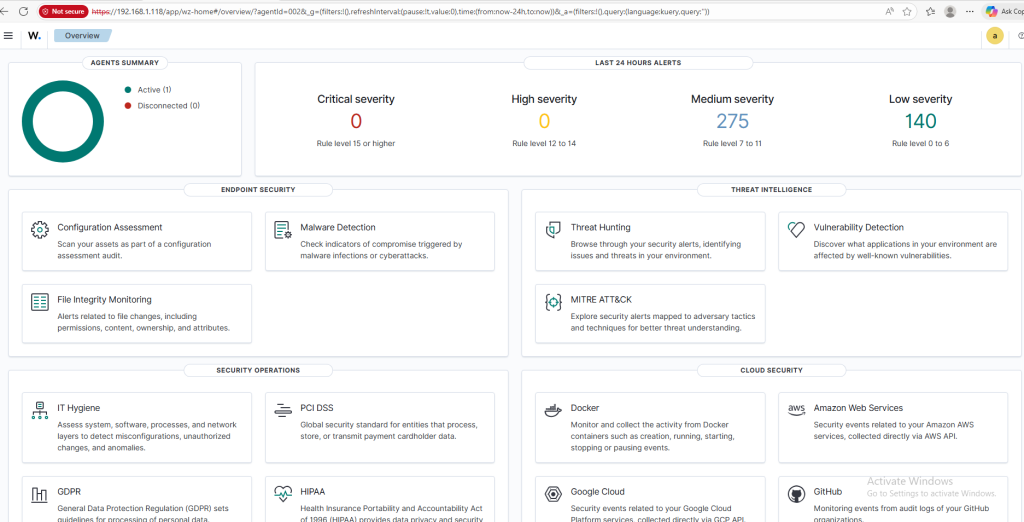
It’s common to hear security vendors promise “full visibility,” but the reality for most organizations is that their Security Information and Event Management (SIEM) system is a noisy, bloated data repository. It’s often viewed as a compliance tool rather than the operational core of Threat Detection. If you’re struggling with alert fatigue, false positives, and slow triage times, your SIEM isn’t broken—it’s unoptimized.
My experience as a Security Analyst confirms this: implementing a few strategic, data-driven architecture changes can deliver massive, quantifiable results. Our team achieved a verifiable 40% reduction in security incidents by moving our SIEM from a data sink to a precise detection engine. Here’s a breakdown of the three non-negotiable optimization pillars that drive this level of risk reduction.
1. Data Quality and Log Correlation: Precision over Volume
The biggest drain on any SIEM’s effectiveness is poor data quality. You can’t achieve effective real-time threat detection if your logs are incomplete, inconsistently formatted, or lack necessary context. Our primary focus was not on adding more logs, but on enriching the logs we already had.
- The Problem with “Spray and Pray”: Many organizations ingest every log from every source. This is expensive and creates an overwhelming noise floor.
- The Solution: Focused Ingestion and Normalization: We prioritized logs with high Indicator of Compromise (IOC) value—firewalls, EDR, authentication services, and critical servers. We then rigorously applied parsing and normalization to ensure all timestamps, user IDs, and source IPs were consistent across the platform. This technical discipline is what allowed us to develop new logic that increased malware identification accuracy by 20%. By reducing junk data, the SIEM could accurately correlate events that were previously viewed as isolated noise.
2. Detection Logic Tuning: The Art of the High-Fidelity Alert
A poorly tuned SIEM is a firehose of false positives, which quickly leads to alert fatigue and the desensitization of your security team. To cut through the noise and achieve a 40% incident reduction, you must shift your logic from generic rules to targeted, high-fidelity alerts based on the MITRE ATT&CK framework.
- Move Beyond Signatures: Signature-based alerts are too slow. We focused on behavioral and statistical analysis. For example, instead of alerting on a known malware hash, we alert on “a service account attempting to execute a PowerShell command followed by large-scale data transfer.” This leverages correlation across multiple log sources.
- Contextual Suppression: We created whitelists and suppression rules that were contextually aware. If a network vulnerability scanner (Nessus) runs every night at 2:00 AM, that specific IP performing a high volume of port scanning should be suppressed from a general “scanning” alert during that time window. This tuning ensured that when an alert did fire, it genuinely warranted immediate Incident Response.
- Focus on the Kill Chain: We rebuilt our rule sets to track movement across the cyber kill chain (e.g., Initial Access, Execution, Persistence). This shift allowed us to detect and interrupt attacks earlier, drastically improving our ability to mitigate cyber risks.
3. Workflow Integration: Tying Detection to Incident Response
An alert that cannot be acted upon quickly is worthless. The final step in optimization is integrating the SIEM with your existing security controls and Risk Management workflows, ensuring a seamless pivot to containment.
- Automated Triage (SOAR): We implemented rudimentary Security Orchestration, Automation, and Response (SOAR) playbooks. For high-confidence alerts (e.g., confirmed phishing URL click), the SIEM automatically triggered a ticket, enriched it with context (asset owner, vulnerability status), and sometimes even performed a simple containment action, like isolating the host via the EDR platform.
- Clear Runbooks: Every single alert was tied to a pre-defined runbook, outlining the exact Incident Response steps, whom to notify, and the critical security controls to check. This structure is what made our response process NIST-aligned and allowed us to enhance resolution speed by a reported 75%.
The result of this integrated, three-pronged optimization is a streamlined Security Operations Center (SOC) where analysts spend less time sifting through noise and more time performing high-value Threat Hunting and strategic risk mitigation. This isn’t just about efficiency; it’s the direct, measurable path to achieving a 40% reduction in security incidents.